Four legs good, two legs better
Animal FarmOld Major's speech to the animals on the night that sparked the Rebellion drew a clear, binary line through the world: "Whatever goes upon two legs is an enemy. Whatever goes upon four legs, or has wings, is a friend." This categorical distinction between the human oppressor and the animal comrade became the bedrock of Animalism, the revolutionary doctrine that the pigs elaborated from the old boar's teachings. When the simpler animals proved unable to memorize the Seven Commandments, Snowball condensed the entire creed into a single, easily remembered maxim: "Four legs good, two legs bad." Inscribed on the barn wall in letters larger than the Commandments themselves, the slogan served as a mental shorthand for the entire rebellion, a mantra that united the farm against the human enemy and promised a future of equality and freedom.
After the expulsion of Snowball and the consolidation of Napoleon's dictatorship, the slogan became a weapon of suppression rather than liberation. The sheep, who had taken to bleating "Four legs good, two legs bad" at every opportunity, were especially adept at disrupting debate; they would burst into the chant at crucial moments, drowning out any voice of dissent. Squealer, the pigs' propagandist, used the slogan to reinforce the idea that the farm's hierarchy was natural and righteous, while simultaneously rewriting history to paint Snowball as a traitor. The other animals, their memories fading and their lives growing harder, clung to the belief that no creature among them "went upon two legs" and that, despite their hunger and exhaustion, they were fundamentally different from the humans who had once enslaved them. The slogan, once a rallying cry for liberation, now served to mask the growing inequality between the pigs and the rest of the animals.
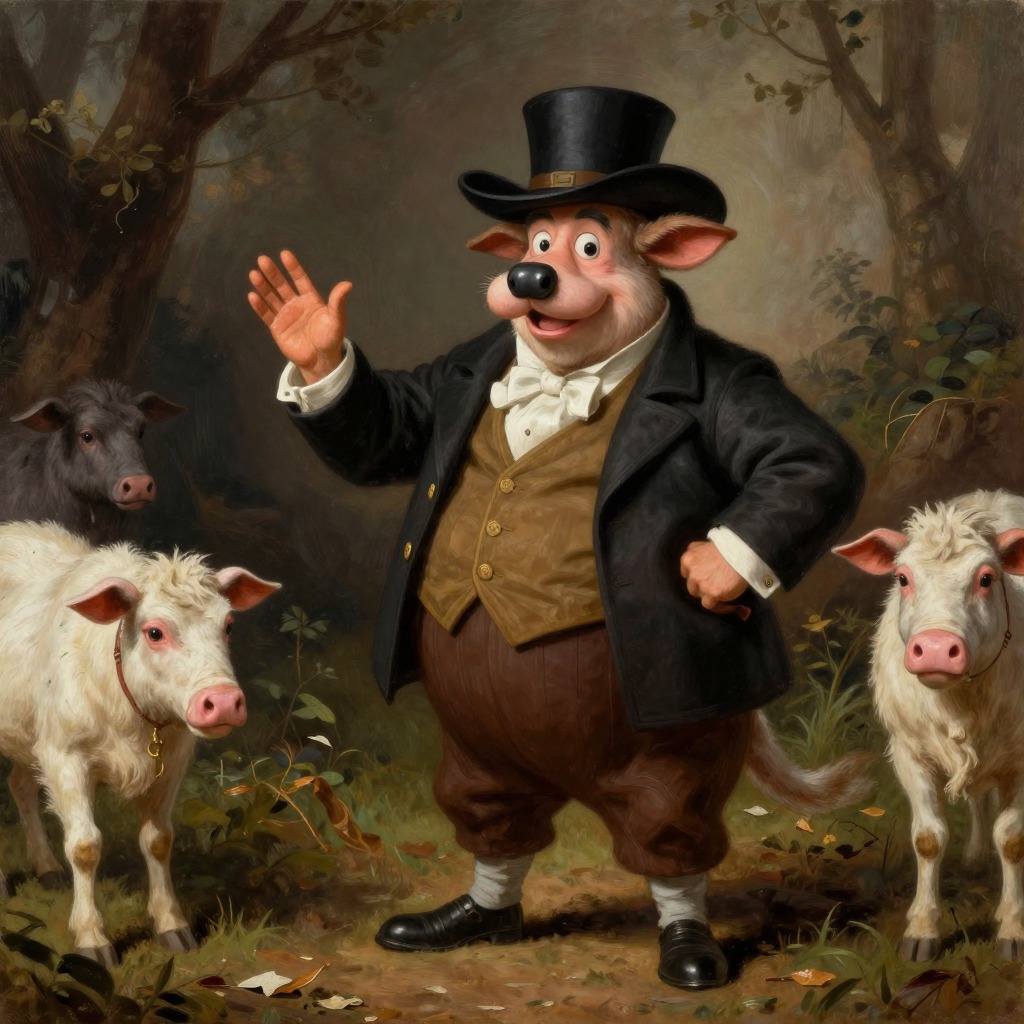
The final, devastating revision of the slogan came on the day the pigs revealed their complete transformation. Squealer, followed by a long file of pigs, walked across the yard on his hind legs. Then Napoleon himself appeared, majestically upright, carrying a whip in his trotter. The animals stood in stunned silence, witnessing the very image of the enemy they had risen against. At that moment, as if on cue, the sheep, who had been sequestered for a week to learn a new song, burst into a tremendous bleating: "Four legs good, two legs better! Four legs good, two legs better!" The chant continued for five minutes, long enough to drown out any potential protest. The new slogan retroactively justified the pigs' human posture, rewriting the foundational principle of Animalism to accommodate the new ruling class. The binary that had once defined the enemy now defined the elite.
With the adoption of "Four legs good, two legs better," the original vision of the Rebellion was not merely abandoned but actively inverted. The pigs, now indistinguishable from humans in their behavior—walking upright, wearing clothes, carrying whips, and drinking alcohol—had become the very thing they had sworn to overthrow. The animals who had once destroyed the symbols of human tyranny, flinging Mr. Jones's whips and ribbons onto the fire, now watched their own leaders adopt those symbols. The final scene of the novel, in which the pigs and the neighboring farmers play cards and quarrel, leaves the observer unable to tell pig from man. The slogan's evolution from "Four legs good, two legs bad" to "Four legs good, two legs better" encapsulates the entire arc of the revolution: a liberating idea reduced to a tool of oppression, and finally to a joke that masks the return of the old order in a new, porcine form.